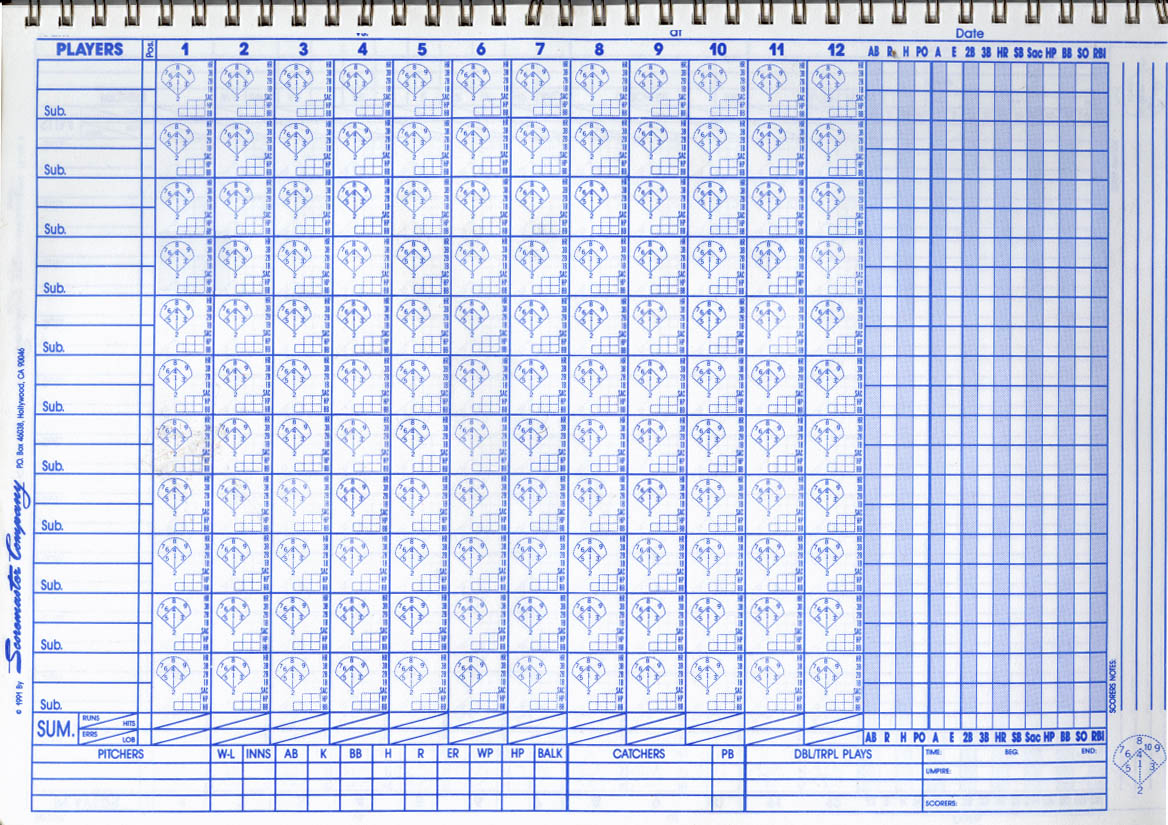
On the first day of the 2010 post season, in a first post season appearance, Roy Halladay gave up one walk on his way to no-hitting the Cincinnati Reds. That walk spoiled my scorecard.
Do you see how in this work, the sixth column of iconography contracts in at the top, expands out at the bottom and skews up towards the top corner? Sort of like a twitch under your eye caused by a bad memory? Or the crumpled front fender of a car that has run into a telephone poll at a high rate of speed?
It's supposed to look like this...
..but the rules say I have to maintain a connection to the cultural artifact it is derived from.
So if Roy Halladay doesn't pitch a perfect game - how am I supposed to score a perfect score card? It's like if Beethoven made a mistake while he was writing the 9th symphony and put in a b-flat instead of a d-flat - is it still a just as beautiful? A rose by any other name would look as beautiful?
You decide.
See the score card for Roy Halliday's no-hitter at the Internet Baseball Score Card Blog.
mh
Friday, October 8, 2010
Tuesday, October 5, 2010
Part Two of How to Read a Baseball Score Card - and how to Score a Baseball Game
Contents
How to Read a Baseball Score Card - how to Score a Baseball Game - Part One
Introduction to Part Two
How to Read a Baseball Score Card - how to Score a Baseball Game - Part Two
Introduction to Part Two
By way of an introduction to scorekeeping in part one, I wrote about the history of the craft. I wrote about how the scorecard had over time become the essential scoring mechanism in baseball, how it is used by teams, leagues, media and fans. It is the only practical way to record a game at the field, it's existence the result of millions of person-hours full of love and discipline over 150 years. I noted how the newspaper box score, and for that matter, all baseball statistics you read anywhere, are derived from the simple scorekeeper's card.
In an ironical counter-point, (and to trumpet my new, and I think important, HTML scoring technique), I noted how in the the Web Age the mainstay of baseball culture, including Major League Baseball, have ignored the history of the craft of scorekeeping and reverted to sentences and paragraphs at their web places to try and record games. ESPN for example devotes an incredible 18 feet of computer screen on FIVE different pages to record one game!
Somehow pencil and paper scoring, where a scorekeeper can record everything that happens in a game on two 11" X 17" notebook pages, has been left out in the transition to digital.
Apple is leading the way with specialized hardware and software that allows one to score at the game in a hand-held, and even print out graphic table-type score cards after the game. But where's the art, the craft, in pushing the appropriate icon button? The beauty of a 11" X 17" score card is that you can see by the amount of ink on it when, what happened - it gives you a sense of the passage of time, a sense of epochs passing in the midst of a timeless game. With all the data deep inside an iPad score keeper all the magic is lost. The simple html score card can be coded to slide around inside a smart phone, or used on a Kindle, or simply on a lap top - and with a quick zoom-out you can see the whole inning - or the whole game.
This loss of the graphical interface, which is the fundamental nature of the score card, isn't the geeky, generally non sports minded web developers fault only; the understanding of the fundamentals of the game of baseball has been waning in the popular culture since 1948, the year "..the Boston Braves [...] decided to sell the television rights to all of their home games for the next two years." (Wikipedia)
Twenty five years later, marked by the introduction Designated Hitter, the media of Television, (which due to it's two dimensional nature is incapable of capturing baseball), had usurped the culture baseball had created - the game would now be less, because the camera could not be more.
Since 1973 AL games have become boring mechanical assembly line affairs, each piece rumbling out at the appropriate moment along the time line, each beautiful, grotesque specialization then doing what they were designed to do, when they were designed to do it ... to the point where the American League fan's only respite from the boredom is to become the game themselves - to cheer like insane monkey at balls hit out of stadia by colossus who's only function is to rise from the bench every eight outs and hit such things - in order that the fan can then become a centre of their own vain calamity.
I maintain that the DH rule is but a bi-product of the dumbing down of the culture of baseball caused by TV's inability to translate the game to fans at home. There are SO many things going on around every pitch, and in such subtle ways, and on such a large field of play that the directors quickly gave up trying to weave a tapestry (if they ever saw it), and focused the camera on the simple, stupid duality - the war between pitcher and hitter, Mano y Mano.
It's like the Coles Notes version of a great novel, or every bad Hollywood adaptation that replaces compexity with a love a story: it results in pseudo-intellectualism, a shallow understanding, and a knee jerk in the seat next to you.
A return to the love and joy of of the game through keeping score I hope will re intellectualize the game on all levels. Those who play the game don't need any help here, they know though doing. The people who need to restart their brains are the 90% of us who don't eat right because we don't play - our metabolism is eager for easy answers, or panacea, preferably sweet ones. We all know there are different flavours of sweet, scoring baseball and thus understanding the complexities of each game is one of them.
I hope this guide and the HTML score card results in a generation of scorekeepers and constructive critics of the game, such that maybe by 2073 we'll have rid ourselves of the DH rule, and TV will look more like an scorecard on a lap top. :)
How to Read a Baseball Score Card - how to Score a Baseball Game - Part Two
The Example Game - August 7th 2010, D-Rays at Blue Jays - bottom half of the innings:
Here in Part Two I will continue from where we left off with our August 7th 2010, D-Rays at Blue Jays example game. We were working our way through the first inning of the game, Travis Snider had walked and scored on a Yunel Escobar double to left centre field. Now with a run in and Yunel Escobar on second, baseball's 2010 home run champion is up to bat - with no one out in the inning.
Monday, October 4, 2010
New code for the Internet Baseball Score Card - with Extra Innings! -
Score Card Coding update
The Internet Baseball Score Card Blog is pleased to announce just in time for the 2010 MLB play-offs, that the functionality of the score card has been improved.
New code for 9 extra innings of AB boxes and Innings Totals boxes, and 5 extra pitchers lines have been added.
BUT you won't see them until you need them!
Code breaks that hide the extra innings can be removed in the time it takes for the networks to come back from a commercial break - like between the 9th and 10th inning.
Here's a couple of images (zoomed out quite a bit) of the HTML Score Card in 9 inning mode, and below that, in 18 inning mode...
If anyone wants to have a look at the new code - or wants use it to score in their own blog - the code is available, free for use with an attribution link, in a Google Document. Please click on the button below to go to the Google Doc..
I checked the code at W3C Validation Service portal as a -//W3C//DTD HTML 4.01 Transitional//! document type, and it came back citing 1 error:

Well ... stupid "invalid formal public identifier" (Obviously I don't know what I'm doing --- but it works!!! :)
(https://docs.google.com/document/edit?id=1ErOa0rBYvI9YVSraJlizpEKIpijLk7d7BVhNXP5v3pc&hl=en)
mh
The Internet Baseball Score Card Blog is pleased to announce just in time for the 2010 MLB play-offs, that the functionality of the score card has been improved.
New code for 9 extra innings of AB boxes and Innings Totals boxes, and 5 extra pitchers lines have been added.
BUT you won't see them until you need them!
Code breaks that hide the extra innings can be removed in the time it takes for the networks to come back from a commercial break - like between the 9th and 10th inning.
Here's a couple of images (zoomed out quite a bit) of the HTML Score Card in 9 inning mode, and below that, in 18 inning mode...
If anyone wants to have a look at the new code - or wants use it to score in their own blog - the code is available, free for use with an attribution link, in a Google Document. Please click on the button below to go to the Google Doc..
I checked the code at W3C Validation Service portal as a -//W3C//DTD HTML 4.01 Transitional//! document type, and it came back citing 1 error:

Well ... stupid "invalid formal public identifier" (Obviously I don't know what I'm doing --- but it works!!! :)
(https://docs.google.com/document/edit?id=1ErOa0rBYvI9YVSraJlizpEKIpijLk7d7BVhNXP5v3pc&hl=en)
mh
Wednesday, August 25, 2010
I can't believe he's a Major League Announcer! #2
This on-going series of blogs doesn't have to be about the things Pat Tabler says - but it probably will be...
I can't keep up with the number of irrelevancies, non sequiturs, missteps of logic, and flat out contradictions, from one statement to the next, that spew out of the mouth of Pat Tabler when he does colour on Rogers Sportnet's Blue Jays games.To quote each one would require a tape recording of each broadcast and a dictation transponder machine. So... I've taken to just shouting "Shut the fcuk up Pat" (al a The Big Lebowski, "Shut the fcuk up Donny"*) every time he says something stupid.
To keep this blog's label, "I Can't Believe He's a Major League Announcer" updated, I've decided to simply report the number of times during each game that Pat Tabler forces me to shout it.
To wit:
New York Yankees at Toronto, August 24, 2010:
13 times
* "Shut the fcuk up Donny, you're out of your element"
Image of Buck Matinez and Pat Tabler from The Blue Jay Hunter.
mh
Friday, August 13, 2010
How to Read a Baseball Score Card - and how to Score a Baseball Game
This continuing series of posts will teach not only how to score using the old paper and pencil method, but as well how to score in a blog - in real time, on the internet - with an html scorecard I'm developing, and computer keyboard scoring notation I've developed to work with it.
Contents
Part One
Introduction
How to score a Baseball Game
Part Two
Introduction to Part Two
Introduction
A few years back I was living at my sister's and scoring Toronto Blue Jays games with paper and pencil. My nephew was interested in what I was doing - out there on the deck after dinner every night, spread out all over the patio table with the radio, coloured pencils, ruler, note book and erasers - when he asked, I explained my scoring notations and pointed out how (almost) everything that happened in the game was recorded on a single sheet of my 14" X 16" artists sketch book. One day a few of years later - I hadn't lived there for several years - I happened to notice a completed scorecard lying on my sister's living room table. My nephew had picked up the craft of scoring baseball games!
I had no example to draw on when I started scoring, drawing perhaps on some 6th sense that was already in my head about what a baseball score card should look like. I don't know why I did it, I felt like it was something that people who watched baseball games did - those that did not were not really watching baseball - they were doing something else. I must have, but I don't know where I'd seen it done. In the age before the internet coming across this century old craft especially up here in Canada was something akin to seeing a palm tree. I must have seen it in movies or perhaps looking at the box scores published in newspapers - which are derivative of a scorecard.
In the last 40 years the history of baseball score keeping, like the history of baseball itself, is going through a period of intense study. What we once thought we knew is constantly being better defined. Gaps in the history are being filled in and mistakes are being filtered out at an alarming rate. 20 years ago I read in a book about the early Brooklyn Dodgers franchise that sporting statistics were first kept by a man working with the Montreal Canadians franchise, around 1900 if memory serves. Today I read at Wikipedia that Henry Chadwick was the first person to keep and publish statistics on the newly forming leagues in and around New York City, in 1857! Sounds more correct than the Montreal story - and the research is backed up with examples, like Beadle's Dime Base-Ball Player edited by Chadwick, which includes stats tables as early as 1861 (Baseball-Reference) and this 1876 scorecard from a rival publication fifteen years later.
1876 Scorecard published in DeWitt's Base-Ball Guide (from bibliopolis)
In the spring of 1992 I started scoring Jays games. I had no idea how special a year it would turn out to be, or how lucky I was to have been closely following such a rare season, as the Blue Jays won the division, the American League Penent and then the World Series. By the finish of that endless season I was pretty confident I could score a ball game as well as anyone - but I still hadn't seen anyone else's score keeping! It's around this time that I began playing recreational, co-ed, slow-pitch, and, at these games they had scorecards!
They were all slightly different, and no one in 'rec' ball scores much more than who's on base and who has scored a run - but these scorecards were basically the same as the ones I had been making - everyone has slightly different ways of notating different things, but generally they were alike.
I don't think I'd ever seen a resource back in the early nineties that taught how to score a game. And even today looking in the Toronto Library system I found ONE such book in their new search-able online data base: "The Joy of Keeping Score" by Paul Dickson.

The craft, it seems is either self taught, handed down father to son, or taught coaches to players in leagues. But the internet is changing all that - the knowledge that exits in the "Brain Trust" at all levels of baseball is being published now in blogs. Coaches and managers who would never have been published in print are now creating blogs where they can easily share their knowledge. The images I'll use in this piece link back to some of them.
This continuing series of posts will teach not only how to score using the old paper and pencil method but also how to score in a blog with an html scorecard in real time on the internet using computer keyboard scoring notations that I have developed to work a html scorecard.
Wikipedia has a page for scoring a baseball game, but for some reason the author has chosen as an example, a messy, badly kept scorecard which, as the author goes from one bad example to the next makes it more difficult than it has to be to understand. I expect that in the anarchy of a confusing talley, subtle points may lost on a beginning scorer.
Better I think to go with a PERFECT scorecard. There is no such a thing - but when I begin to score a game, that is my intent at any rate. I've been trying to score a baseball game 'perfectly' for 20 years - it still hasn't happened. But then I haven't scored a game where both pitchers pitched perfectly either; in which case one might expect to have a simple, perfect scorecard - although an infinity long...
MLB has a specific set of rules for scorekeepers to follow that guarantee a 'Box Score' can be created from the complete game scorecard. Because of space limitations, newspapers like to publish only 'Box Scores', rather than the complete game scorecard - over the years as scorecards were lost, these newspaper box scores were the only remaining historical record of many games.To the left is an old newspaper clipping from a 1908 New York Times article with a box score at the bottom. Below, is an example of a typical Box Score from the internet era, this one is from an August 7th 2010 game between the D-Rays and the Blue Jays published at MLB.com.

We're seeing the top half of the page (see the whole thing), not shown, below the fold, are lists and tables and paragraphs showing each teams totals numbers; base hits, triples, home runs, and errors. Also there are tables and lists and paragraphs showing the names of pitchers who pitched in the game; pitch totals, walks, base hits, strike outs, ERA's and so on .
I'm boycotting MLB because of their pay-for-view meme, I have more experience at ESPN so I'll use a typical ESPN Box score an an example here. Every MLB game is recorded at ESPN on 4 separate pages: Recap, Box Score, Play-by-Play and Pitch-by-Pitch - for a total of 18 FEET of computer screen. All that information can be recorded on a scorecard like the one below - which is 17" X 11", times two teams equals 34 inches by 11 inches.
Below is a typical scorecard (for one team):
I've built an html scorecard that allows people to use a computer keyboard to make notations and score a game in Blogger that has ALL the information ESPN records on 18 feet of screen - in 5 feet on my scorecard. AND it's in an at-a-glance table format like the age old paper and pencil method that for example, allows you to quickly scan the AB boxes and see immediately who was the game MVP, and how and when runs were scored.
How to score a Baseball Game
Below is an example of a recent game at Rogers Centre in Toronto, Ontario, Canada. I scored this with my html score card, it was "live-blogged" (I clicked publish after every at-bat) and remains an historical artifact at the Internet Baseball Score Card Blog.
This is the complete game score card scoring of the game I used as an example of a box score from MLB above from August 7th 2010, D-Rays at Blue Jays. These are the Blue Jays at-bats.

To explain how to score a baseball game I'm going to use image examples of my keyboard scoring method - along side images of the old paper and pencil method.
The Box Score you see in print media newspapers are only a tiny part of the complete game scorecard. Essentially, the box score is a synthesis of the totals columns in a score card.
At the end of each players row of At-Bat boxes (AB box) for example are these headings (from the image on the right).

- AB = at bats
- R = runs scored
- H = hits
- RBI = runs batted in
- SO = strike outs
- BB = bases on balls
AB boxes
AB boxes describe every plate appearance in the game.
In the close-up on the left, at the top are the players names : the lead off hitter and just below the number two hitter... . To the right of the names in this image are the first and second inning AB boxes - where the life cycle of a player's actions in the offensive half of each inning are recorded. The defences actions are also recorded in these boxes.While scoring a game, it is always on the scorekeepers mind that the totals columns need to be completely and accurately filled in at the end of the game. The notations you make in the AB boxes must allow you to fill out the totals columns accurately later.
In my paper and pencil scoring days I used the 'diamond from above' style, like in the image above - it's the easiest way to show the base runners progress with pencil and paper. I now use notations that I can produce with a computer keyboard.
To the right is a close up of the scorecard above, it shows the first and second batters (Snider and Escobar), and first and second inning AB box (just like the paper and pencil image above). This html AB box consists of five boxes; four little boxes - one on top of the other where pitches thrown are recorded - and a long rectangular box where the 'life-cycle' of that batter's activity in the first inning, and the defences plays as well, are recorded. In this case lead-off hitter, Travis Snider walked on 6 pitches. The 'BB' means base on balls, the '<>' means he eventually scored a run.In real time, a base on balls (BB) would look like these images that I made to demonstrate. below left is the html score card - the one on the right, is a typical pencil and paper scoring...


..note the pitches that were called BALLS by the umpire are noted in the html scoring example, in the small boxes on the left as 'B'. 'S' is a STRIKE (swinging), and 'C' is a STRIKE (called) by the umpire.
The 'BB' on the second line in the large rectangle, in the life-cycle box means that the player received a 'base on balls' as ruled by the umpire. The '-', indicates he is standing on first base. Similarly a notation '--', indicates 'on second base'; a '---', indicates 'on third base'. A run scored is indicated by '<>'.
In the pencil and paper version the called balls are noted with pencil dots (in the upper left corner), the line drawn on the bottom right side of the diamond indicates the player is standing on first base, the 'BB' outside of the diamond, below and to the right of the line, indicates how he got there.
In our example game the next batter is Yunel Escobar hitting second, after lead-off hitter Travis Snider. As you can see in the image on the right, the first pitch to Escobar was a called strike, 'C'. The next pitched ball was put into play by Escobar, hitting it ('X'), in this case, very hard...The notation on the second line of the life-cycle box, '2BH7(8)' means Escobar hit a 'two base hit' [2BH] to left-centre field [7(8)]. It means neither the left fielder, nor the centre fielder could get to the fly ball before it hit the ground between them and bounded to the wall. Because Escobar was able to get to second base it becomes more likely in the readers mind that the ball probably bounced all the way to the wall before the left fielder '7' finally got to it and threw it in, while the centre fielder '(8)' backed up the play.
(The number 7 comes first because the player playing that position got to the ball first - (8) indicates location, half way between the 7 position (left field) and the 8 position (centre field) - thus 7(8).)
The next line, 'RBI' means 'run batted in'. Travis Snider the man who was on first, came all the way around and scored (now the reader knows for sure the ball went all the way to the wall). Snider's run scored is the 'run' in the 'run batted in' (RBI) that Escobar was credited with. Snider's run is indicated in his life-cycle box by changing the '-', to a '<>'.
In a paper and pencil scorecard the scorer would complete drawing a line on each of the three sides of the diamond that were not lined yet, and then in many cases, the diamond would be penciled in solid so the reader can easily see when, and by whom, runs scored.
[Some people like to leave them these plated runs diamonds open because they put 'HR' inside the diamonds that represent home runs hit. These HR moments are bigger than the game, bigger than the team's standing for some of these people - they are very sick, pay no attention to these people. ;) ]
Next, under the run batted in notation in Escobar's life-cycle box is the notation, '--' indicating Escobar is standing on the second base bag.
So... you may say,
'You've showed me what goes on the 2nd, 3rd, 4th, and 5th lines of the life-cycle box, why did you leave the 1st line of the box empty?'
And that would be a good question.
The answer to that question is: that is where the note goes for what happens before the ball was struck into the field (or the batter was called out by the umpire). For example if Travis Snider had stolen 2B while Escobar was batting, notes would be written into both Escobar's and Snider's life-cycle boxes. In Snider's box: SB 1,2 (stolen base (SB) from first base (1) to seconf base (2) ) - and in the top line of Escobars box would appear: #1 1,2 (the first batter in the order (#1) moved from first base (1) to second base (2) ) --- to show the reader when Snider stole the base.
Now Jose Bautista is up - and still no one out!
There is a run in, a runner is in scoring position at second; and Baseball's best home run hitter this year is up.
Yay! :)
To be continued in Part Two...
Image links:
Typical newspaper column - report of a baseball game, New York Times 8.01.1908
Batters totals boxes, and at-bat boxes from, "Guide to Scoring Baseball" by Christopher Swingley.
A typical box score, from MLB (August 7th 2010)
Empty scorecard example, from Lefty Parent.com
Scorecard example from, Internet Baseball Score Card Blog, Saturday, August 7th 2010.
Typical pencil and paper scoring images from, "How to score baseball"
mh
Monday, August 9, 2010
Schadenfreude reference in "Two And A half Men" sitcom
..or as Nelson Muntz would say, "Ha-ha."
Over at Allan Wood's "Joy of Sox" there is a series called Schadenfreude (A Continuing Series). If the New York Yankees are plummeting in a hellish burning ball of flames towards the leagues basement - or they lose a game - Allan takes delight in mocking them in the popular 'Schadenfreude' posts.Only when it's appropriate though.
(Image from, Schadenfreude 31, Cleveland Indians oust Yankees in 2007 ALDS.)
Today in New York, on the eve of a three game set with Boston in Toronto, the Bostons beat the 'MFY'*.
So I thought it would be a good time for a bit of themed gamesmanship directed at Boston fans via the CBS hit show "Two And A half Men"... with some really cool references, like...
..apparently there isn't a German word for the feeling of guilt that comes after the feeling of Schadenfreude - but in this episode, Charlies crazy neighbor Rose, invents the word: "Gloukenstoucken" (at 19:00 minutes).
But in the world of obsessive, fanatical baseball team worship, Gloukenstoucken should only happen after your team's performance may leave you feeling that the feeling of Schadenfreude is developing in the fans of other teams nearby - and you may need to steal yourself for the abuse to come - because your catcher is batting .176 and you just lost your number three, power hitting first baseman with a broken thumb, and your only 4 games ahead, of all teams, the Toronto f*#king Blue Jays (TFJ).
But really, there is no word for that, so the feeling and the protection it may offer probably doesn't really exist.
Them's the breaks. :)
Boston at Toronto - Game 1
Tuesday, August 10, 2010
First pitch: 7:07PM
Rogers Centre
Toronto, Ontario, Canada.
* Joy of Sox glossary for MFY.
Joy of Sox "Schadenfreude" label.
Source link: Two And A half Men Season 2 ep 5
mh
Sunday, August 8, 2010
Brandon Morrow Complete Game - No Hitter ruined with 2 outs in the 9th
(click on image for larger view - opens in new tab/window)
Above: The fateful final inning. Morrow loses his bid for a no-hitter in the 9th, with 1 out to go.Below are the game notes I wrote while scoring the Jays game at the Internet Score Card - the almost no-hitter by Brandon Morrow - starting when it became apparent something special was happening. My first mention comes in the 5th...
All the outs and the hit, a VIDEO: Scroll Down (found via Huffington post)
Top of the 5th
Not to be-little the euphemism, but the strike zone is as wide as it can be with out confusing wild pitches with strikes in the scoring.
Bottom of 5th
Molina is on with a walk, and on a scorcher foul, hit by Wise, 1B D. Johnson can't get around Molina, who he is playing behind, to get to the ball before it twists foul - so he plays in front of him now. Molina is joking around, decrying the diss. Then he starts with a jogging run to second - and then the pitcher winds - Molina steals it on the pitcher, standing up.
Top of 6th
Bartlett swings and dives at the same time and the high inside pitch hits the barrel of the bat as he bails. Umpire thinks it's off his shoulder, but Cito Gaston asks him to get another opinion. They reverse themselves and meanwhile we're watching video that clearly shows it hit the bat - foul ball. Next pitch is K eleven for Morrow.
Zobrist with 2 outs now, hits a long line drive blast. Wells has the line... and he hits the wall as the ball hits the pocket of his glove extended in a complete stretch near the top of the wall - for the out!
Euphemism still intact.
Vernon Wells dislocated his big toe on the catch above, and is replaced by Snider as a pinch hitter and in CF by Wise from left field and Snider into LF.
Top of the 9th
Brandon Morrow's no hitter is broken up by a Evan Longoria with a skidder between 1st 1nd 2nd. Aaron Hill dives for it, but it goes in and out of his glove and off into right.
I thought the umpire squeezed Morrow on the Zobrist BB at bat. I think I could see Morrow saying to himself, f*#k it, I'm just going to pitch around him, put him on and start over with Crawford.
This team is really loose and happy with themselves. While Morrow is talking to the Sportnet announcers a bucket of ice water is tipped on Brandon's head, and just about gives him a heart attack. As he's getting ready to begin again with the interview a towel full of shaving cream arrives. Morrow is not amused. A real serious major league pitcher - and that's probably part of the reason why - he's got ice water in those veins.
The Toronto Blue Jays sweep the Tampa Bay Rays.
After a day off tomorrow the 3rd place Boston Red Sox arrive for a 3 game set, 7:07 PM, Tuesday, August 10, 2010.
ESPN Box score for this game.
Morrow gets a complete game 0-1 win with 17 strike outs on 137 pitches and 97 strikes with only 2 bases on balls. 4 runners reached all afternoon.
mh
Subscribe to:
Posts (Atom)